If you’ve been playing pool for a year or two on a house cue — the cue that lives in the wall rack at the bar or came bundled with your table — you’ve probably reached the point where you want something that actually belongs to you. A personal cue is one of the first real upgrades a billiards player makes: it’s a stick, typically 57–58 inches long, made in two pieces that screw together, and designed to transmit force and spin from your hand to the cue ball with as little interference as possible. The shaft — the skinnier front half — is where most of the engineering action happens. Right now, two very different schools of thought compete for the intermediate player’s budget: the Viking Valhalla series, a refined take on traditional maple-wood craftsmanship at an accessible price, and carbon fiber shafts, a newer generation of composite materials that swap wood grain for aerospace-derived tubing. This article maps the real tradeoffs — performance, feel, durability, and dollar value — so you can make a clean decision rather than a coin flip.
What You’re Actually Choosing Between
Let’s be precise about the comparison, because it’s easy to blur the categories.
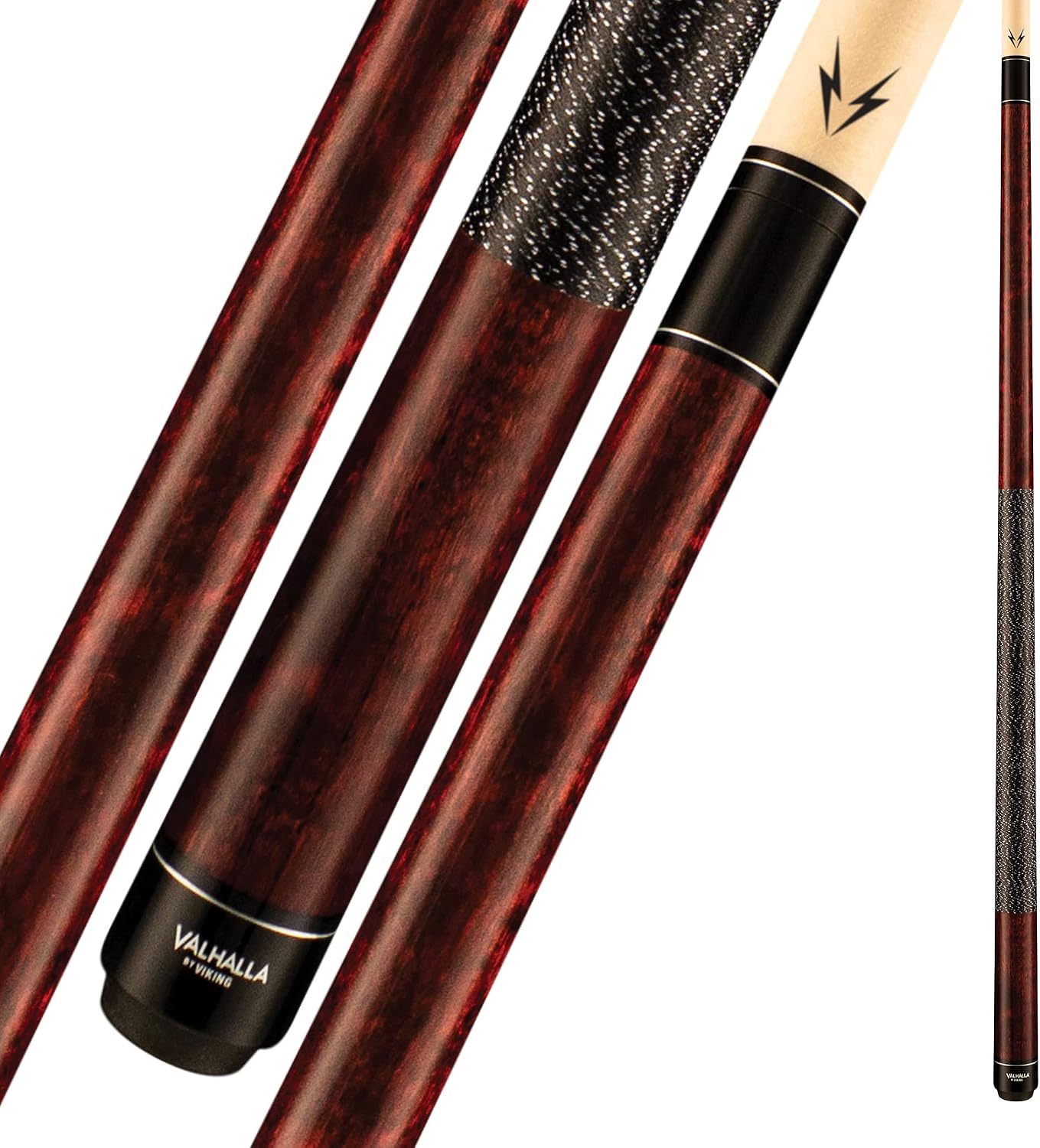
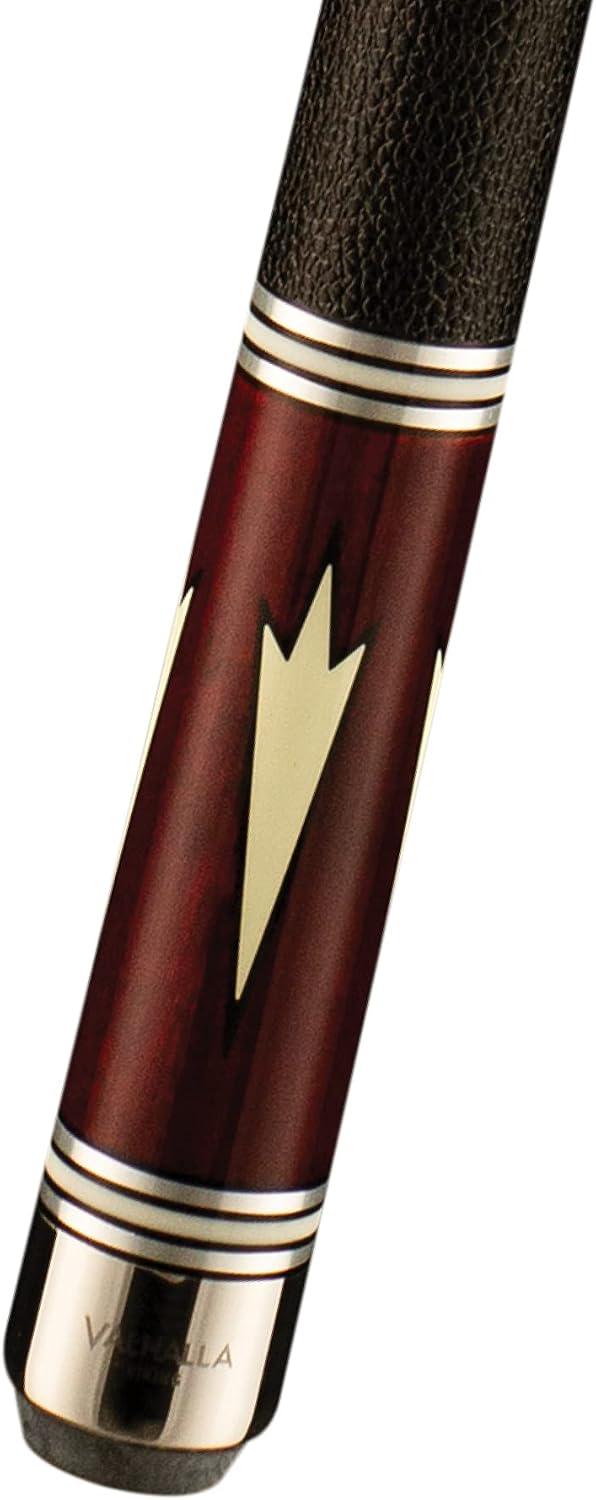
Viking Valhalla is a complete two-piece cue — butt and shaft — sold as a matched set. Viking Cue Manufacturing, a Wisconsin-based company with a decades-long reputation in mid-market billiards, produces the Valhalla line as their entry-into-intermediate offering, typically retailing in the $70–$150 range depending on configuration and finish. The shaft is Canadian hard rock maple, tapered to a 13mm tip — the small cap at the very front that contacts the cue ball. The Billiard Congress of America Equipment Specifications and Standards document establishes 13mm as the accepted standard tip diameter for American-style pool play, and Viking builds consistently to that benchmark.
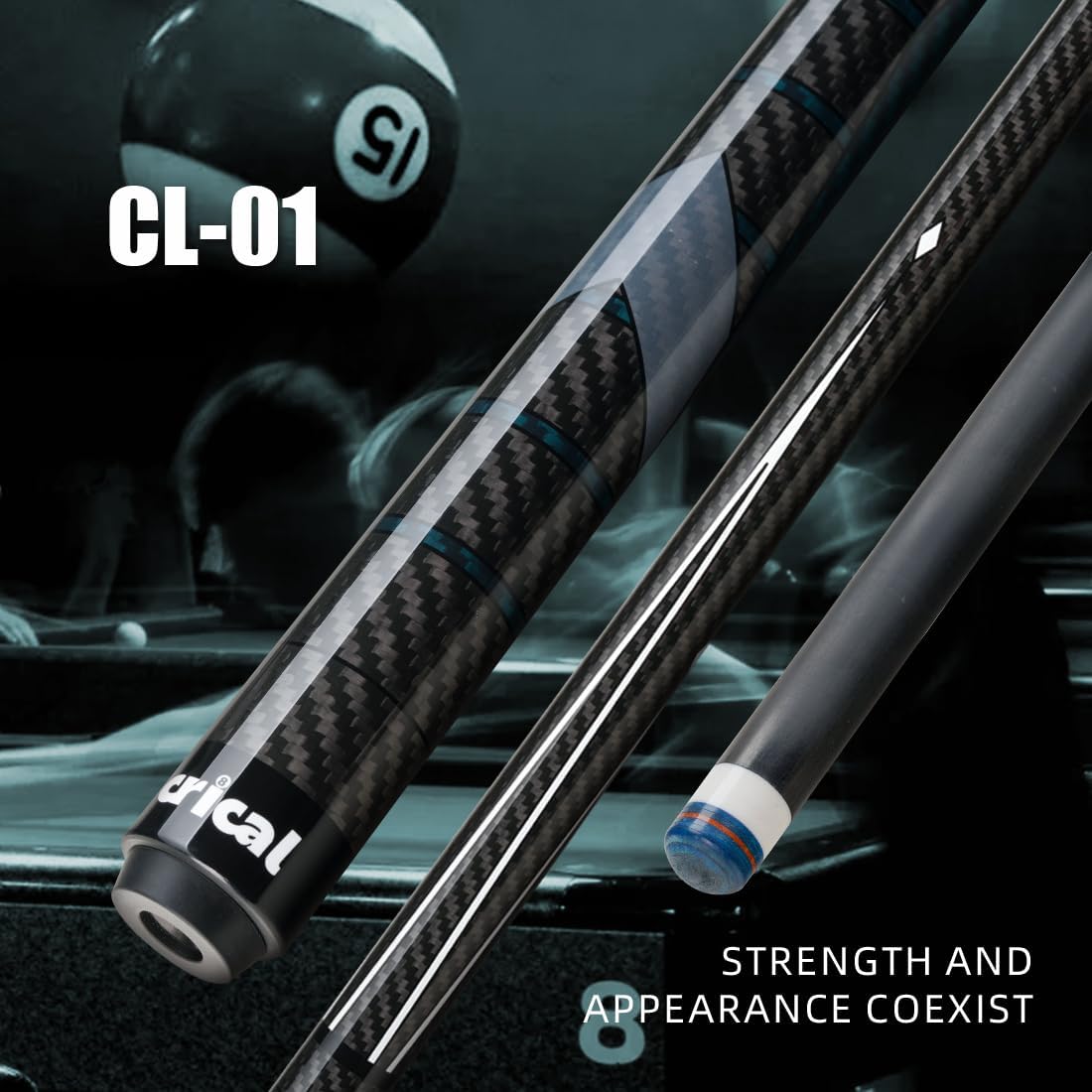
Carbon fiber shafts are aftermarket upgrades. You typically keep your existing butt and swap only the shaft. Brands like Predator (the Revo line), Cuetec (Cynergy), and OB Cues lead this category. Carbon fiber shafts run $150–$400+ as standalone shafts, with Predator Revo at the high end and Cuetec Cynergy entry models providing a more accessible on-ramp. The material is a woven composite tube, sometimes with a hybrid core, finished to a smooth playing surface. The pitch to players: near-zero deflection, immunity to humidity and temperature warping, and a longer functional lifespan.
The real comparison, then, is not Viking Valhalla cue versus carbon fiber cue — it’s closer to a complete traditional-wood package at roughly $100 versus an aftermarket shaft upgrade at $200–$400 that must be mated to a butt you either already own or need to purchase separately. That asymmetry matters enormously for the math.
The Performance Variables That Actually Separate Them
Deflection: The Biggest Technical Argument for Carbon Fiber
When you apply sidespin — striking left or right of the cue ball’s center — the shaft flexes slightly during impact, pushing the cue ball off the line you aimed at. That’s deflection, sometimes called squirt. Experienced players compensate instinctively; intermediate players fight it constantly.
Low-deflection shafts reduce this effect through hollow or reduced-density tip-end construction. Carbon fiber shafts extend this principle further because the material’s stiffness-to-weight ratio is dramatically higher than maple. Gear Patrol’s Best Pool Cues 2025 Edition notes that player consensus around carbon fiber shafts consistently identifies deflection reduction as the most immediately noticeable performance difference for players who regularly use spin and English.
Viking Valhalla shafts are standard-taper solid maple — not engineered for low deflection. If you’re already comfortable compensating for squirt, this is workable. If you’re actively trying to build a cleaner spin game without years of compensatory muscle memory already in place, the gap is real and it compounds with every session.
Viking
$145.00
In stock on Amazon
Check price on AmazonFeel and Tactile Feedback
This is where carbon fiber’s physics work against its marketing copy. Maple transmits vibration in a way players have described for generations as “alive” — tactile feedback on every shot tells your hands something about contact quality and stroke path. Carbon fiber dampens that vibration. Depending on who you ask, the result reads as smooth and precise, or as muted and “plastic.”
Sports Illustrated Reviews’ Best Pool Cues Buying Guide identifies this tactile divide as the primary reason carbon fiber shafts have not fully displaced wood at intermediate recreational levels despite their measurable technical advantages. Players who learned on wood and rely heavily on feel-based stroke feedback sometimes find the adjustment genuinely difficult and return to maple. Players who prioritize repeatability and precision tend to adapt within a few months and don’t look back.
The Viking Valhalla’s maple shaft does what maple has always done: it gives you honest, immediate feedback. For a player still building foundational stroke mechanics, that feedback loop can accelerate learning in ways that a dampened composite shaft may not.
CRICAL
$129.00
In stock on Amazon
Check price on AmazonDurability, Warping, and Maintenance
Here is where carbon fiber earns a clear, uncontested win. Maple warps. Not dramatically, not overnight — but over years of storage in a basement game room cycling through seasonal humidity swings, a wood shaft can develop a slight bow that is nearly impossible to reverse. Wood shafts also require periodic light sanding to remove chalk residue and skin oil buildup that drags against your bridge hand and slows the stroke.
Carbon fiber does not warp, does not absorb moisture, and requires almost no maintenance beyond wiping down after play. Popular Mechanics’ Pool Cue Buyer’s Guide specifically flags carbon fiber shafts as having a meaningful lifespan advantage in home game room environments — basements and garages being the primary humidity problem zones for recreational players. If your table is in a climate-controlled living space, this advantage narrows. If your setup is in a basement that swings 30 percentage points of relative humidity between January and July, it is a significant practical consideration that compounds annually.
Viking
$275.00
In stock on Amazon
Check price on AmazonSide-by-Side at a Glance
| Feature | Viking Valhalla (complete cue) | Carbon Fiber Shaft (standalone) |
|---|---|---|
| Typical price | $70–$150 | $150–$400 |
| Tip diameter | 13mm standard | 11.75mm–12.75mm (varies by brand) |
| Deflection profile | Standard taper | Low to ultra-low |
| Warping risk | Present with humidity swings | None |
| Maintenance required | Periodic shaft sanding | Wipe-down only |
| Adjustment period | Minimal — familiar feel | 4–12 weeks for most players |
| Butt included? | Yes | No — budget separately |
| Best for | Beginners to early-intermediate | Intermediate players optimizing spin |
| CRICAL — $129.00 | CRICAL — $129.00 | — |
| Viking — $145.00 | — | Viking — $145.00 |
| Viking — $275.00 | — | Viking — $275.00 |
The Budget Logic: Where the Money Actually Goes
This is where intermediate players most often mis-frame the decision. The Viking Valhalla at $100 looks like the budget option and the carbon fiber shaft at $250 looks like the premium option — but that math only holds if you are comparing two shelf-ready complete cues.
If you already play on a $150–$300 mid-range butt — say, an OB Cues Ozone, a Players cue, or an entry-level Meucci — then adding a Cuetec Cynergy shaft at roughly $170 current retail converts a mediocre complete setup into a genuinely upgraded playing experience without starting from zero. You are spending $170, not $400+, and you are keeping a butt you have already broken in and adjusted to.
Conversely, if you are starting from scratch with no butt, no cue, and a tight budget, the Viking Valhalla makes compelling sense. You are getting a playable, properly-specced, durable traditional cue that will outlast most recreational play cycles without demanding anything special from you technically or financially. The Billiard Congress of America Equipment Specifications and Standards confirm that a standard 13mm maple shaft with a medium-hard leather tip is appropriate for all American pool formats at recreational and intermediate competitive levels. Valhalla checks every box for legitimate play.
The mistake to avoid: buying a cheap, no-name $40 butt just to have something to attach a carbon fiber shaft to. Sports Illustrated Reviews’ Best Pool Cues Buying Guide notes that a premium shaft on a poorly-jointed, flexible budget butt delivers a confusing and unsatisfying feel — the butt’s vibration patterns undercut exactly what the carbon fiber shaft is engineered to eliminate. If you are going carbon fiber, budget meaningfully for the butt as well.
Who Should Choose What
The decision splits clearly along two variables: how much spin you currently use and where your table physically lives.
The Case for Viking Valhalla
Go with Viking Valhalla if you are a recreational home player who plays mostly center-ball shots and is still building foundational stroke mechanics. The traditional maple shaft gives you honest tactile feedback that can accelerate skill development during the formative phase of your game. If your game room is climate-controlled and humidity is not a variable you need to manage, the durability argument for carbon fiber weakens considerably. And if your total cue budget sits under $150 with no existing butt to repurpose, the Valhalla delivers a complete, playable, standards-compliant cue without requiring any secondary purchases or equipment research. Gear Patrol’s Best Pool Cues 2025 Edition acknowledges that well-made wood cues in this price band continue to represent strong value for recreational players who are not yet optimizing for spin geometry.
CRICAL
$129.00
In stock on Amazon
Check price on AmazonThe Case for a Carbon Fiber Shaft Upgrade
Go with a carbon fiber shaft — paired to a quality butt — if you are actively working on spin and English and want to reduce the compensation overhead your brain carries on every shot with sidespin. The deflection reduction is a real, measurable advantage that becomes more meaningful the more you rely on cue ball positioning through spin. If your table lives in a basement or garage with genuine seasonal humidity swings, Popular Mechanics’ Pool Cue Buyer’s Guide makes clear that wood shaft maintenance and warping risk become ongoing friction points that carbon fiber eliminates entirely. And if you already own a mid-range butt you are happy with, a Cuetec Cynergy shaft is the most accessible entry point in the carbon fiber category and converts a good setup into a great one without requiring a full equipment overhaul.
Viking
$275.00
In stock on Amazon
Check price on AmazonThe Strategic Middle Path
Some intermediate players deliberately choose a standard-taper wood cue like the Valhalla specifically to build deflection compensation into their muscle memory, planning to graduate to low-deflection or carbon fiber equipment later with a stroke that can handle anything. That is a legitimate strategic choice — it produces players who are not dependent on low-deflection technology to execute spin shots. A combined approach — starting on Valhalla for six to twelve months, then transitioning to a carbon fiber shaft once the fundamentals are locked in — gives you the feedback advantages of wood during the learning phase and the precision advantages of composite once your stroke is consistent enough to benefit from them. It is also a longer road financially, since you are eventually buying both. Neither path is wrong. They just produce different players with different dependencies.
Viking
$145.00
In stock on Amazon
Check price on AmazonThe Honest Summary
Viking Valhalla and carbon fiber shafts are not really in direct competition. They serve slightly different versions of the intermediate player at different moments in their development.
Valhalla is a complete, well-made traditional cue that overdelivers at its price point. It is the right call for players starting from scratch on a defined budget who are still building stroke fundamentals and want honest feedback from their equipment.
Carbon fiber shafts are a targeted technical upgrade — meaningful for players who are losing shots to deflection and fighting humidity-related maintenance — but they require a more deliberate setup and a higher upfront investment to realize their full benefit. The Billiard Congress of America Equipment Specifications and Standards remind us that the baseline requirements for competitive pool are not exotic: consistent tip diameter, reliable joint, and a straight shaft. Both options meet that standard. What separates them is what you need beyond the baseline.
The best cue is the one that removes the most obstacles between your intention and the cue ball. At this stage of the game, only you can calibrate which obstacles are actually slowing you down.