If you’ve ever watched a cue ball curve unpredictably or felt like the table was playing slow no matter what you did, there’s a decent chance the cloth — the fabric surface stretched across the slate — was the culprit. Pool table cloth (commonly called “felt,” though quality playing cloth is actually a woven textile, not true felt) is one of the most performance-critical and least-understood parts of the game. The weight of the cloth (measured in ounces per yard), the ratio of wool to synthetic fiber in the weave, and even the color you pick all have real consequences for how the ball rolls, how long the cloth lasts, and how the room looks five years from now. This guide breaks all of it down in plain terms: what the numbers mean, which specs matter at which price point, and how to avoid the regrets that show up in owner threads on AZ Billiards and r/billiards once the installer has left and the table is already in play.
Oz Weight: The Number That Actually Tells You Something
Cloth weight is measured in ounces per running yard (a standard 62-inch-wide strip). The practical range you’ll encounter runs from roughly 18 oz at the budget end to 30 oz at the heavy worsted end, with most recreational tables shipping from the factory somewhere in the 20–24 oz zone.
Here’s the counterintuitive part: heavier is not automatically better for play. Oz weight interacts with fiber construction in ways that matter more than the number alone.
Lighter cloth (18–21 oz): Thinner weave, more nap (the fuzzy fiber surface), slower ball speed, more directional inconsistency. Entry-level tables from brands like Viper, Fat Cat, and Hathaway typically ship with cloth in this range. It’s durable enough for family use but will noticeably slow the game and can cause spin (“english”) to behave inconsistently — the nap grabs the ball differently depending on which direction you’re shooting.
Mid-range cloth (21–24 oz): The workhouse tier for serious recreational play. Olhausen’s standard cloth spec and many Brunswick factory installs land here. Ball speed and roll consistency improve meaningfully over budget cloth, and the surface resists wear well under regular use. This is usually the right answer for a basement game room that sees a few sessions a week.
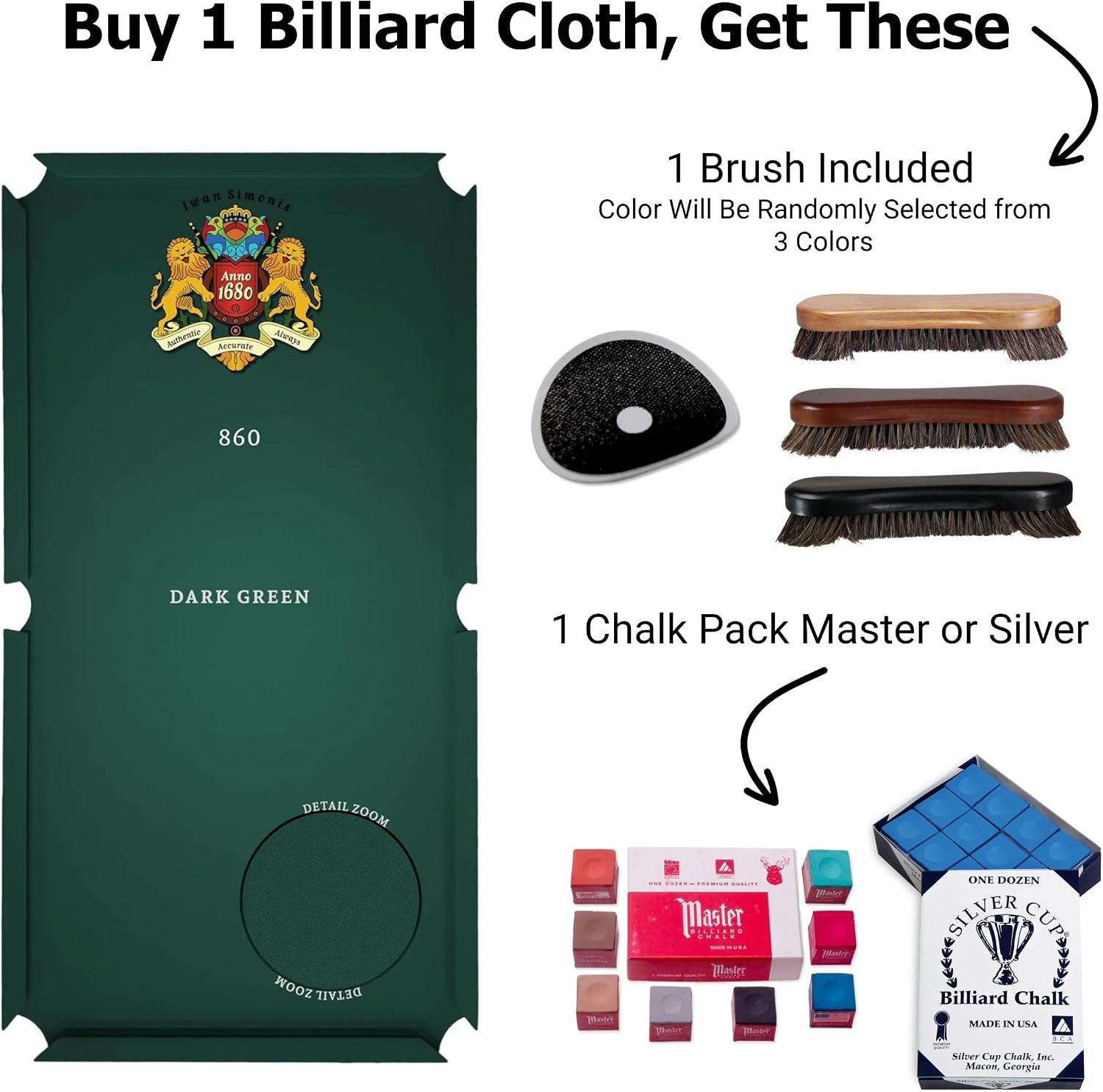
Heavy worsted cloth (28–30 oz): This is tournament and bar-table territory. Simonis 860 — the cloth specified by the World Pool-Billiard Association (WPA) for international competition, per the WPA’s Tournament Table and Cloth Standards document — sits in this range. The tight, dense weave produces a fast, consistent surface with minimal nap interference. Ball reaction to spin is predictable and immediate. The tradeoff is price: a full 9-foot re-cloth in Simonis 860 runs $300–$500 in cloth cost alone before labor, versus $80–$180 for commodity cloth at the same table size.
By the numbers:
| Cloth Weight | Typical Ball Speed | Best Fit | Approx. Cloth Cost (9-ft set) |
|---|---|---|---|
| 18–20 oz | Slow | Entry-level / casual | $40–$80 |
| 21–24 oz | Medium | Recreational / home room | $80–$180 |
| 28–30 oz (worsted) | Fast | Serious amateur / tournament | $250–$500 |
Worsted vs. Woolen: The Spec Most Buyers Miss
Oz weight is visible on every product listing. The worsted vs. woolen distinction is buried — and it matters more.
Woolen cloth is made from fibers that are carded (combed loosely) before spinning. The resulting weave has a visible nap — a directional fuzz, like the surface of a billiard ball rolling through grass. This is what most people picture when they say “felt.” Woolen cloth is slower, more forgiving of imperfect shots, and more prone to wearing unevenly, pilling, and developing directional inconsistency as it ages. It’s also less expensive to produce.
Worsted cloth is made from fibers that are combed in parallel and tightly woven, then sheared smooth. There is no nap. The surface looks almost like a fine suit fabric — you can see the weave. Ball speed is faster, shot-to-shot consistency is higher, and the cloth resists the matting and wear patterns that eventually make woolen cloth play differently in the center of the table than at the rails. Simonis 860 is worsted. Simonis’s own technical documentation describes the 860 as a “pure new wool, worsted, napless” cloth — those three words together are the quality signal worth knowing.
The tradeoff for home players: Worsted cloth plays faster, which is an advantage only if your skill level can use it. On a fast table, positional errors are punished more severely — balls fly past their targets, and position play requires tighter control. Many intermediate players report (consistently in AZ Billiards owner threads) that a re-cloth to Simonis 860 exposed weaknesses in their speed control they didn’t know they had. That’s not a reason to avoid it; it’s a reason to go in with eyes open.
The hybrid option: Simonis offers the 860HR (“Home Recreation”) — a slower-speed worsted cloth that keeps the napless consistency and durability of the 860 but at a deliberately reduced ball speed closer to mid-range woolen cloth. For a home player upgrading from a factory-cloth table who wants the consistency gains without the speed shock, the 860HR is the choice most reviewers and forum regulars recommend as the practical on-ramp to worsted play.
Color: It’s a Design Decision with Performance Consequences
Pool table cloth comes in a wide spectrum, from tournament green and competition blue to burgundy, charcoal, black, and custom colors that Olhausen, Connelly, and Plank & Hide will specify through their dealer networks. The color decision has three real dimensions: visual contrast, UV fade resistance, and resale flexibility.
Visual contrast for play: The ball-to-cloth contrast affects how clearly you read the table during a shot. Tournament green (a medium-value, mid-saturation green) was standardized partly because it provides reliable contrast against both the white cue ball and the full range of object-ball colors in 8-ball and 9-ball. The Billiard Congress of America’s Equipment Specifications note that competition surfaces must use approved cloth — and approved colors cluster around the green-to-blue-green spectrum for exactly this reason. Very dark cloth (charcoal, black) can make reading ball position harder in lower-light conditions, which matters less in a well-lit game room and matters more as ambient lighting dims. Bright or high-chroma cloth (red, orange) creates high contrast with green-adjacent balls and lower contrast with red-adjacent ones.
Fade and longevity: Darker saturated colors — especially black and deep red — tend to show UV fade more visibly than medium-value greens or blues. If your room has substantial natural light exposure, this is a real consideration. Owners on AZ Billiards forums who have installed dark cloth in sun-adjacent spaces consistently report visible fading within 12–18 months without UV-blocking window treatment. Simonis’s product line includes cloth in over 20 colorways; their technical data makes no specific fade-resistance claims by color, but the general principle holds across woven wool textiles.
Resale and design flexibility: If there’s a reasonable chance you’ll move the table or sell it within the next five to seven years, neutral colorways (tournament green, competition blue, camel/tan) keep the table broadly marketable. Custom colors are a legitimate design choice for a room you’re building as a long-term space — Plank & Hide and Connelly dealers will walk you through custom felt specs as part of a full room build — but a deep burgundy table in an otherwise neutrally finished room is harder to re-home.
Making the Call: Decision Rules by Situation
This is where the specs collapse into a clear framework.
If you’re re-clothing a table that gets casual family play (under 10 hours per week): Don’t overspend on worsted cloth. A 21–24 oz woolen cloth from a reputable mill — Championship Billiard Fabric and Hainsworth both produce reliable mid-range options that show up consistently in positive owner reviews — gives you meaningful improvement over factory cloth at a fraction of the Simonis price. Budget $100–$200 including a single set of rail cloth.
If you’re re-clothing a home table where you practice seriously (10+ hours per week, working on pattern play and spin control): The Simonis 860HR is the call. It’s the one option that delivers worsted consistency at a speed most intermediate players can actually use without relearning speed control from scratch. Expect to pay $300–$450 in cloth alone for a 9-foot table; factor in $150–$250 for professional installation. The total $500–$700 investment on a table you already own is still a fraction of what a new table costs, and owners who have made this move report that the improvement in shot-to-shot consistency is immediately noticeable.
If you’re buying a new table in the $3,000–$10,000 range from Brunswick, Olhausen, or Connelly and evaluating the factory cloth option vs. an upgrade: Ask the dealer explicitly what cloth weight and construction the factory install uses. Many mid-tier factory installs use 20–22 oz woolen cloth — adequate but not exceptional. Upgrading to worsted cloth at point of sale is almost always less expensive (in combined cloth + labor) than re-clothing 18 months later, because the installer is already there.
If color is the question: Default to tournament green or competition blue unless the room design actively demands something different. Both colorways provide reliable ball contrast, age gracefully, and remain broadly marketable. If you’re specifying a design-forward room with a Plank & Hide or Connelly table as the room’s anchor piece, bring the cloth swatches to the space before committing — color reads differently under billiard lighting than in a showroom.
One last thing worth saying plainly: cloth installation quality matters as much as cloth quality. A premium Simonis install done with improper tension or misaligned seams will play worse than a mid-range cloth done correctly by an experienced installer. The Billiard Congress of America maintains a certified mechanic directory — verifying your installer against that list before booking is twenty minutes well spent.
The cloth is the interface between the game and everything you’ve spent on the table underneath it. Get it right and every session pays the investment back. Get it wrong and you’re re-doing it in two years anyway.