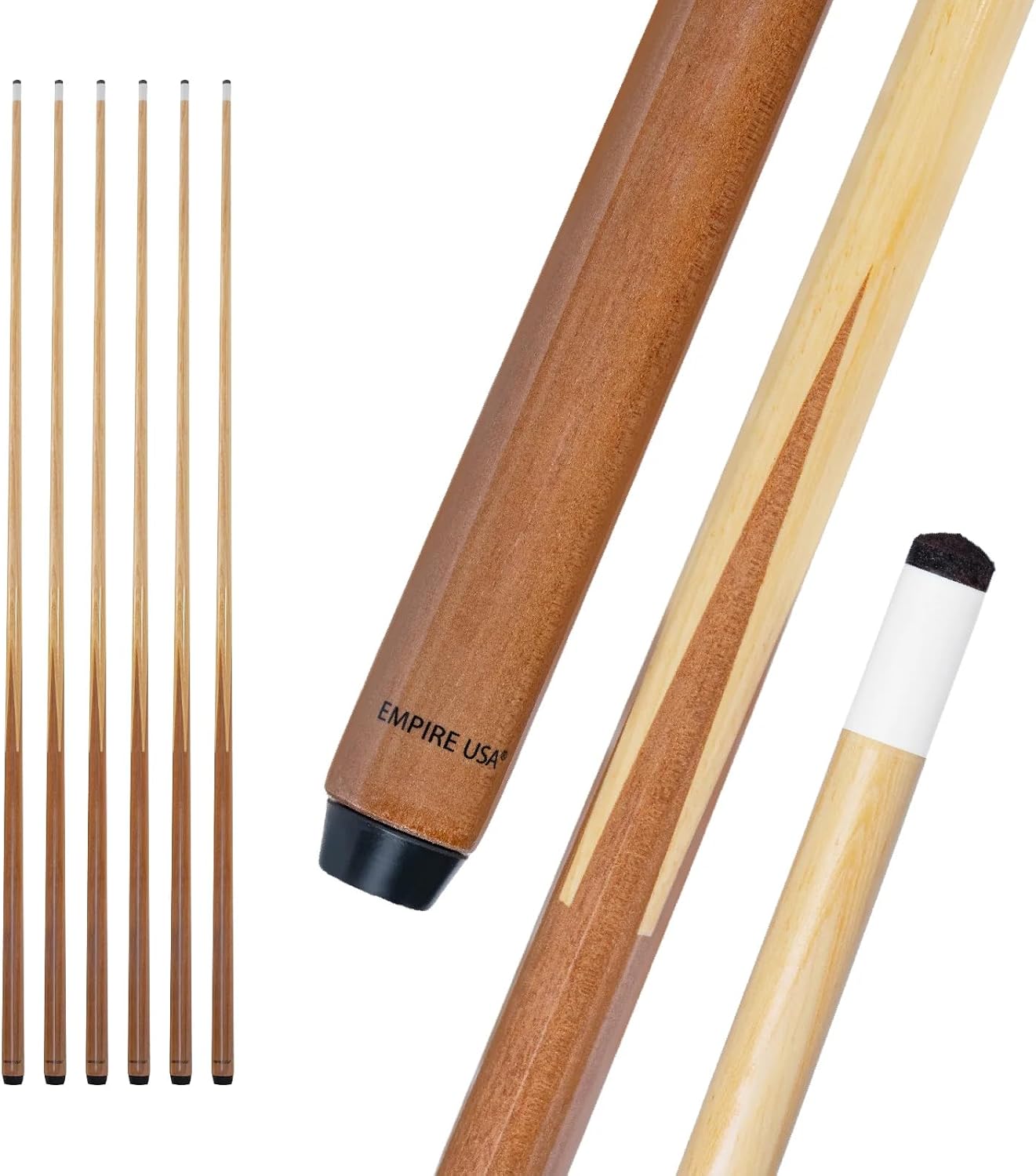
A house cue is the stick that comes with a pool table or sits in a wall rack at a bar or rec room — it’s a shared, utilitarian tool, usually a one-piece maple rod with a factory-glued tip, built to survive abuse rather than deliver precision. For casual play, that’s perfectly fine. But if you’ve started caring about where the cue ball ends up after every shot — if you’re thinking in terms of position play (planning two or three shots ahead) rather than just sinking the object ball in front of you — a house cue is actively working against you. The shaft flex, tip hardness, and balance point of a cheap stick all influence how reliably you can deliver the tip to the cue ball at the same angle, with the same force, every time. This guide walks through every meaningful upgrade step in the cue market as it stands in mid-2026: what changes at each price tier, what the tradeoffs actually are, and exactly when it’s worth spending more.
| EDITOR'S PICK[Viking Valhalla 200 Series 2 Pi…](https://www.amazon.com/dp/B07PB6HYYW?tag=greenflower20-20) | Mid-tier[Viking Valhalla 100 Series with…](https://www.amazon.com/dp/B00NI4M4OU?tag=greenflower20-20) | Budget pick[Empire USA Set of 6 Pool Cues -…](https://www.amazon.com/dp/B07VK4R9WW?tag=greenflower20-20) | |
|---|---|---|---|
| Length | 58" | 58" | 57" |
| Weight | 19 oz | 19 oz | — |
| Construction | 2-piece | 2-piece | 1-piece |
| Wrap style | Irish Linen | Irish Linen | — |
| Tip size | — | — | 13mm |
| Count in set | 1 | 1 | 6 |
| Price | $160.00 | $145.00 | $89.99 |
| See on Amazon → | See on Amazon → | See on Amazon → |
Why the Shaft Material Is the First Decision, Not the Last
Most buyers focus on looks — the inlays, the stain, the wrapping — and treat the shaft as a secondary consideration. That’s backwards. The shaft is the part of the cue that actually contacts the cue ball (through the tip), and its stiffness, taper, and material determine two things that matter enormously once you’re playing with any kind of intent:
Deflection (sometimes called “squirt”) is the degree to which the cue ball veers off the line of the shaft when you apply side spin. A shaft that deflects more forces you to aim off-center to compensate — workable once you’ve internalized it, but a moving target as you switch equipment. Low-deflection shafts (a specific engineering category, explained below) reduce this effect, making spin shots more predictable.
Consistency is simply whether the shaft behaves the same on the 500th stroke as the first. Solid maple, the standard shaft material from roughly $30 to $300, is excellent wood — straight-grained, dense — but it is still wood. It responds to humidity changes in a basement, it can develop a slight bow over time, and the grain structure varies cue to cue.
Here’s where the three main material camps land:
| Shaft type | Typical price range (shaft only) | Deflection | Humidity sensitivity |
|---|---|---|---|
| Standard maple (one-piece or two-piece) | $30–$150 cue | Moderate–high | Moderate |
| Low-LD maple (thinned forearm, carbon/fiber core) | $100–$300 shaft add-on | Low | Low–moderate |
| Full carbon fiber | $200–$600 shaft add-on | Very low | Near-zero |
The Billiard Congress of America’s Equipment Specifications document (2024 edition) sets no material restrictions for recreational or amateur play — shaft material is purely a performance and preference choice at every level below sanctioned professional competition.
The Four Upgrade Stages (and What You’re Actually Buying at Each One)
Stage 1: The $60–$150 Two-Piece Cue — Getting Off House Cues
The single most important early upgrade isn’t about exotic materials. It’s about owning your own cue, in two pieces (which allows it to fit in a case and travel), with a consistent weight and balance point you’ve chosen. This is the upgrade that actually changes your practice habits, because you stop accommodating a random stick and start building muscle memory around a specific tool.
At this price range — brands like Viper, Rage, and players’ entry lines from Predator — you’re getting a solid maple shaft, a leather tip that’s been machine-pressed rather than hand-shaped, and a basic linen or Irish linen wrap on the butt (the lower half you hold). The joint (the threaded connection point where the two halves meet) is typically a simple 5/16×18 stainless steel pin. It works. It’s durable enough.
What you’re not getting: a carefully selected shaft blank with consistent grain runout, a tip that’s been properly shaped and scuffed for chalk retention, or meaningful deflection reduction. Owners across the AZ Billiards forum long-run threads consistently report that cues in this range play well for 12–18 months before the tip needs replacement — a $10–$15 procedure any local pool hall or billiard shop handles in minutes.
Decision rule: If you’re practicing more than twice a week and you don’t own your own cue, this is the move. Don’t skip it in search of a better tier. The consistency habits you build with your stick matter more than shaft material at this stage.
Stage 2: The $150–$400 Performance Maple Cue — Where the Game Starts to Click
This is the most crowded and most rewarding tier in the cue market right now. Brands like Lucasi, Predator’s Sport line, and Players Technology Series (the HXT shafts) live here, along with custom-adjacent brands like Viking and Meucci. The jump from Stage 1 isn’t about prestige — it’s about measurable engineering differences:
- Shaft taper: Higher-quality cues specify their shaft taper precisely — typically a pro taper (consistent diameter from about 12 inches above the tip to the joint) versus a European taper (gradually widening from tip to joint). Pro taper is standard in the U.S. amateur and competitive scene.
- Tip quality: Layered leather tips (brands like Kamui, Moori, and Triangle are referenced repeatedly in Gear Patrol’s 2025 buyer guide as the benchmark options at this tier) replace the factory-molded tip. Layered tips hold their shape longer and provide more consistent chalk adhesion.
- Joint construction: Radial pins, wood-to-wood joints, and 3/8×10 configurations appear at this tier. The joint affects the “feel” of the hit — how much vibration transfers to your hand. Owners who’ve moved from Stage 1 to Stage 2 frequently describe hitting as feeling “crisper” or “more solid.”
The Popular Mechanics overview of pool cue selection notes that shaft deflection becomes a real performance variable once a player is intentionally using English (side spin) to shape position — which typically corresponds to players in this 150–400 range who’ve moved past purely potting shots. That’s the moment a low-deflection shaft starts paying dividends rather than just feeling like a premium feature.
Decision rule: If you’re deliberately practicing English and finding your aim compensation inconsistent — or if you’re playing with people who are measurably better and want to understand why — this is where you look. Don’t spend Stage 3 money until you’ve plateaued here for at least six months of regular practice.
Stage 3: Low-Deflection Shafts — The $200–$400 Shaft Upgrade
This is where the conversation gets genuinely technical, and where players sometimes spend money before they’re ready to use it. A low-deflection (LD) shaft achieves its reduced squirt through one of two approaches: a hollow or thin-walled construction near the tip end of the maple shaft (reducing the mass that the cue ball is pushing against during side-spin shots), or the integration of carbon fiber or fiberglass in the shaft’s core.
Predator’s Z-shaft, Mezz’s EC-i shaft, and Lucasi’s Hybrid shafts are consistently referenced in the Sports Illustrated Reviews 2025 buyer guide as the benchmark LD maple options. They run $150–$300 for the shaft alone (your existing butt can be retained if the joint specification matches). Full carbon-composite hybrid shafts, like the Predator Revo or Cuetec Cynergy, move into the $300–$600 shaft range.
The core tradeoff: LD shafts reward players who have a consistent, straight stroke. If your delivery has any wobble or side-to-side variance, a low-deflection shaft won’t fix it — it’ll just make your misses go in a slightly different direction. Owners in the AZ Billiards long-run threads note a consistent adjustment period of 4–8 weeks when switching to LD, during which natural aim compensation (built for a higher-deflecting stick) has to be consciously unlearned.
By the numbers:
- Standard maple shaft: ~12–18 mm deflection at 12 inches, varies by brand
- LD maple shaft: ~6–9 mm deflection under identical test conditions (per manufacturer published specs)
- Carbon fiber shaft: ~3–5 mm deflection (per manufacturer published specs, Predator and Cuetec technical sheets)
Decision rule: If your stroke is grooved — you can pocket balls confidently and you’re now working specifically on shot-making with heavy English — an LD shaft is a legitimate performance investment. If you’re still developing your straight-ball game, it isn’t.
Stage 4: Full Carbon Fiber — The $500–$1,200 Cue Build
Pure carbon fiber shafts — not carbon-core maple hybrids, but shafts where the entire shaft is a woven carbon tube — represent the current engineering ceiling for deflection reduction and consistency. The Predator Revo 12.4 and Cuetec Cynergy CT-15 are the names that appear most frequently across Gear Patrol’s and Sports Illustrated Reviews’ 2025 roundups as the reference-point options.
The practical advantages over premium LD maple: near-zero humidity response (critical in basements with seasonal humidity swings), surface hardness that resists denting and warping over years of use, and the lowest available deflection numbers. The practical disadvantages: a distinct “feel” that some players — particularly those accustomed to the slight flex feedback of maple — find sterile or disconnected. This is an aesthetic preference, not a performance defect, but it’s real and worth knowing before spending $400+ on a shaft.
Worth flagging: carbon fiber shafts require specific care. Chalk selection matters more, as some chalks abrade the surface coating over time. Brands like Predator publish specific chalk compatibility recommendations in their product documentation.
Decision rule: If you’re playing in league competition, practicing seriously five or more times per week, and your current LD shaft feels like a limitation rather than a tool — or if you’re a basement room owner dealing with significant seasonal humidity and you’ve warped a maple shaft — carbon fiber earns its price. It’s the terminal upgrade, not the starting point.
The Honest Summary: Spend in Order, Not in Advance
The upgrade path from house cue to carbon fiber is real and rewarding — but it only pays off in sequence. Every tier in this stack assumes you’ve maxed out the tier below it. A player whose stroke isn’t yet consistent doesn’t benefit from a $400 low-deflection shaft; they benefit from 200 more hours with a solid $180 two-piece and a quality tip. The equipment follows the skill ceiling, it doesn’t create it.
If you’re building a home game room and selecting a cue alongside your table purchase, the Sports Illustrated Reviews 2025 pool cue guide recommends landing in the $150–$300 range for a first “real” personal cue — enough quality to grow into for 2–3 years of regular play without overspending on features you haven’t yet developed the game to use. That’s the honest middle ground between the house cue drawer and the carbon fiber build, and for most serious home players, it’s exactly where you want to be.