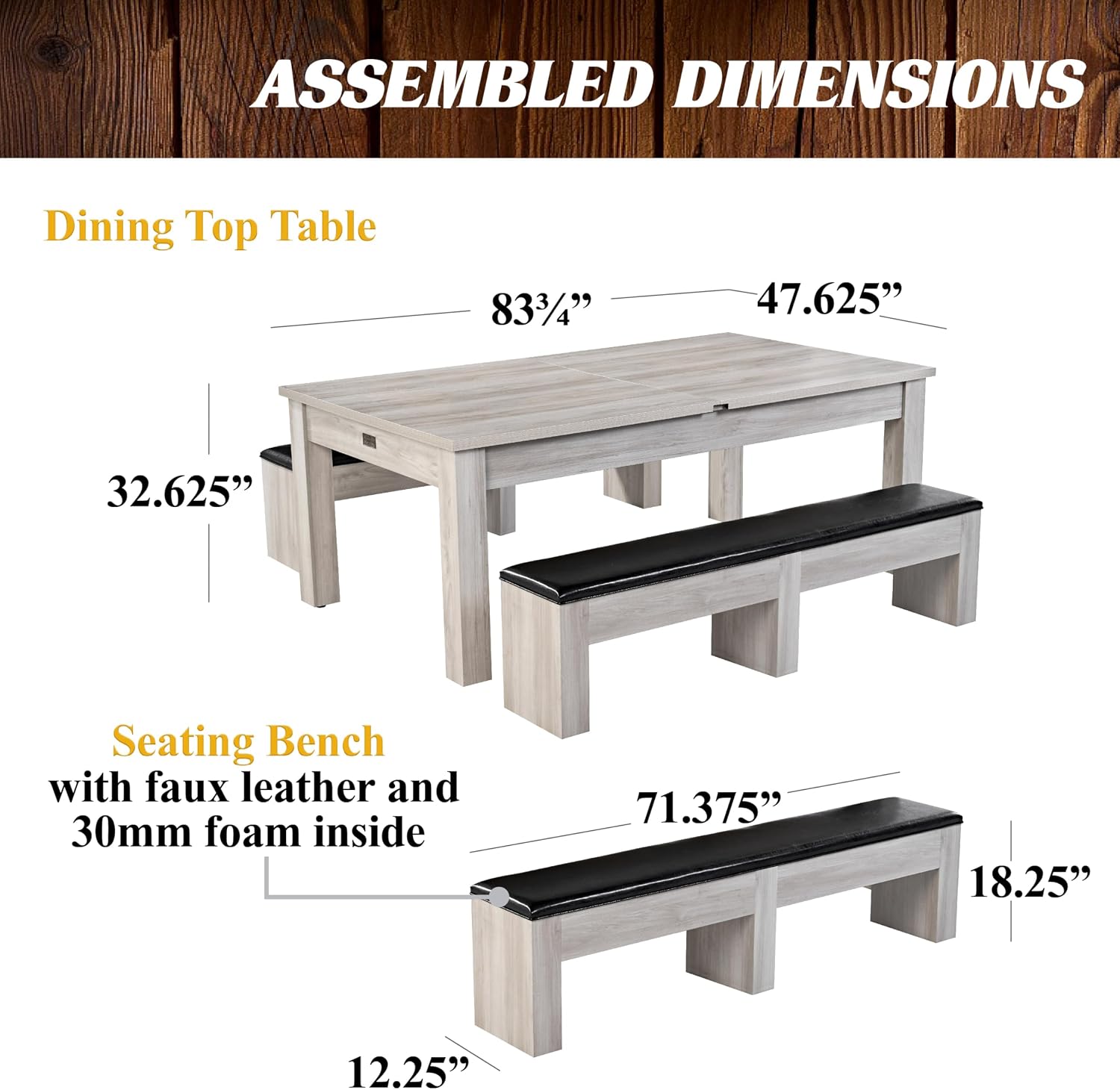
If you’ve been shopping for a game room table and noticed options labeled “3-in-1” or “convertible,” you’ve stumbled into one of the most genuinely useful — and genuinely compromised — product categories in recreational furniture. The concept is straightforward: a single table ships with a hard dining top and a ping pong conversion top, so the same piece of furniture handles billiards (the game played with a cue stick on a cloth-covered flat surface), family dinners, and table tennis (ping pong) depending on what you drop on top of it. For a 400-square-foot basement rec room shared between a pool-playing parent, a middle schooler, and a holiday dinner crowd, that pitch is hard to argue with on paper. This article is going to give you the honest version of that pitch — what the format actually delivers, where it cuts corners, and how to decide whether a combo table or a dedicated pool table is the smarter buy for your specific situation.
The Core Tradeoff You Need to Understand Before You Shop
Let’s name it plainly: every engineering decision in a multi-game combo table is a negotiation between pool-table performance and product versatility. A dedicated pool table is designed around one job. A 3-in-1 is designed around three jobs, and physics doesn’t give you those three jobs for free.
The slate question is where it starts. Slate is the dense, naturally flat stone that forms the playing surface bed in serious pool tables. The Billiard Congress of America’s Equipment Specifications and Rules document designates one-inch-thick slate — typically in a three-piece configuration for tables 8 feet and larger — as the standard for competitive and tournament play. Slate holds its flatness over years and across humidity and temperature changes. The vast majority of combo tables in the $500–$1,500 price range use MDF (medium-density fiberboard) or a synthetic composite instead of slate. MDF is lighter (essential when a dining top needs to be lifted and moved by two people) and dramatically less expensive. It is also susceptible to warping over time, especially in basement environments with humidity variation.
This Old House’s pool table buying guide draws a clear line between slate and non-slate beds, noting that non-slate tables are appropriate for casual recreational use but cannot replicate the consistent roll that slate provides. If you are a regular billiards player — someone who cares about whether a ball drifts on a long roll across the table — you will feel the difference. If you are a once-a-week casual player whose main interest is having something to do at a party, you may not.
The cushion situation compounds this. The rubber cushion (called a “rail cushion” or “bumper”) that lines the inner edge of the table and causes balls to rebound is calibrated to specific geometry standards. The BCA references the K-66 cushion profile as the industry standard for competitive play — it’s the shape of the rubber cross-section that determines the angle and speed at which a ball comes off the rail. Combo tables almost universally ship with generic rubber that approximates this profile rather than meeting it precisely. Owners on the AZ Billiards forum consistently report that rail response on combo tables feels “dead” or “unpredictable” compared to even a mid-range dedicated slate table. This matters most for bank shots and kick shots — the skill-building strokes that serious players practice most.
What the Combo Format Actually Does Well
This is not a hit piece. There are genuine use cases where a 3-in-1 combo table is the correct answer, and getting that wrong in either direction costs money.
Space efficiency is real. If your room can only accommodate one large piece of recreational furniture, and you want pool, ping pong, and an occasional dining surface, a combo table delivers three functions in the footprint of one. Bob Vila’s buying guide notes that the minimum recommended room clearance for a standard 7-foot pool table is approximately 5 feet on all sides — meaning you need a room of roughly 12 × 16 feet minimum just to play comfortably. A combo table occupies the same footprint but earns that footprint across multiple use cases throughout the week.
The dining top is often genuinely nice furniture. Premium combo brands like Plank & Hide and Connelly offer convertible dining options in solid hardwood with dovetail joinery and hand-rubbed finishes that hold up as legitimate dining room furniture. At this tier — $3,500 and above — you are not buying a compromise; you are buying a deliberate design object. The playing surface still uses a thinner slate configuration or an engineered stone composite in some models, but the cabinetry and aesthetic are intended to anchor a room. Game-room designers specifying these pieces for high-end residential clients treat the dining conversion as a feature, not a workaround.
The ping pong top is the easiest conversion to evaluate. Table tennis has its own governing standards (the International Table Tennis Federation specifies a 9-foot by 5-foot playing surface, 2.5 feet off the ground), and a conversion top placed over a 7- or 8-foot pool table is not going to replicate ITTF competitive conditions regardless of price point. But recreational ping pong — the kind played at family gatherings and dorm rooms — works fine on a good-quality conversion top. The net assembly matters more than most buyers realize; owners consistently report that cheap clip-on net systems loosen and shift during play, and a more stable post-and-clamp system is worth prioritizing.
By the Numbers: Combo vs. Dedicated Tables at Each Tier
| Scenario | Typical Price Range | Slate? | Cushion Standard | Best For |
|---|---|---|---|---|
| Entry combo (MDF bed) | $400–$900 | No | Generic rubber | Casual family play, parties |
| Mid combo (engineered composite) | $900–$1,800 | Rarely | Approximate K-66 | Regular casual, space-constrained rooms |
| Premium combo (slate bed, hardwood) | $2,500–$5,000+ | Yes (some) | Near-standard | Design-forward rooms, committed multi-use |
| Dedicated slate table (mid-tier) | $800–$2,500 | Yes | K-66 standard | Serious recreational players |
| Dedicated slate table (premium) | $3,000–$10,000+ | Yes (3-piece) | K-66 / pro grade | Enthusiasts, competitive players |
Popular Mechanics’ pool table coverage notes that three-piece slate construction — where the slate bed is delivered in three sections and leveled individually at installation — is the accepted standard above the $2,000 price point for dedicated tables. Almost no combo table at any price uses three-piece slate, because the conversion mechanism requires a lighter, more uniform bed.
The Specific Playability Losses to Budget For
If you are coming from a dedicated slate table and considering a combo table as a cost-saving or space-saving move, here is what the published specs and aggregated owner reports say you should expect to give up:
Consistent roll on long shots. An MDF or composite bed will develop micro-warping over 12–24 months in a basement environment with seasonal humidity shifts. Owners on AZ Billiards report that shots that roll true in year one begin to show subtle drift in year two, particularly near the center of the table where the bed is unsupported by the rail.
Rail energy and predictability. Generic cushion rubber hardens faster than quality K-66 rubber, and it starts with less consistent rebound geometry. Bank shots are harder to calibrate because the angle of return varies slightly depending on where along the rail the ball contacts. For players who are actively building their game — learning to read angles, developing a kick-shot library — this is a meaningful setback.
Cloth quality and felt behavior. Combo tables typically ship with a low-nap billiard cloth (the woven fabric covering the playing surface, often called “felt”) in the 18–20 ounce weight range. Tournament-grade worsted cloth starts at 21–24 ounces and plays faster with more consistent directional roll. This Old House’s buying guide recommends asking specifically about cloth specification when evaluating any table purchase; most combo tables ship with the minimum viable cloth and leave aftermarket upgrades to the owner.
Leveling stability over time. A three-piece slate table that has been professionally leveled stays level. An MDF combo table relies on adjustable leg levelers that can shift with floor movement and heavy use. Owners report re-leveling combo tables two to four times per year in finished basements with concrete subfloors, versus once every few years for properly installed slate tables.
The Decision Rule
Here is the “if X, then Y” frame that should cut through the remaining ambiguity:
If you play pool more than twice a week, care about improving your game, or are comparing brands like Brunswick, Olhausen, or Connelly for a room designed around billiards — buy a dedicated slate table. The combo format will frustrate you within 12 months. Spend your budget on a single-purpose table with three-piece slate, K-66 cushions, and quality cloth. A used Olhausen or Brunswick in the $1,500–$2,500 range on the secondary market will outperform any new combo table at twice the price.
If your room genuinely cannot support a dedicated pool table plus additional recreational furniture, your household plays billiards once or twice a month at a casual level, and you need functional dining or ping pong capability — a mid-tier combo table in the $1,200–$1,800 range with an engineered composite or entry-level slate bed is a legitimate choice. Set accurate expectations on playability, budget $150–$300 for a cloth upgrade in year two, and recognize that you are buying recreational furniture, not a billiard table.
If you are designing a premium game room and want the combo format as a design statement — look specifically at Plank & Hide and Connelly’s convertible hardwood options above $3,000, where the cabinetry and finish quality justify the piece as furniture independent of the playing surface. At this tier, the playability gap narrows considerably, and the dining conversion becomes an aesthetic asset rather than a compromise.
The combo table category is not a scam, and it is not a secret weapon. It is an honest tradeoff between versatility and performance, priced to match. Know which side of that tradeoff your household actually lives on, and the buying decision becomes straightforward.