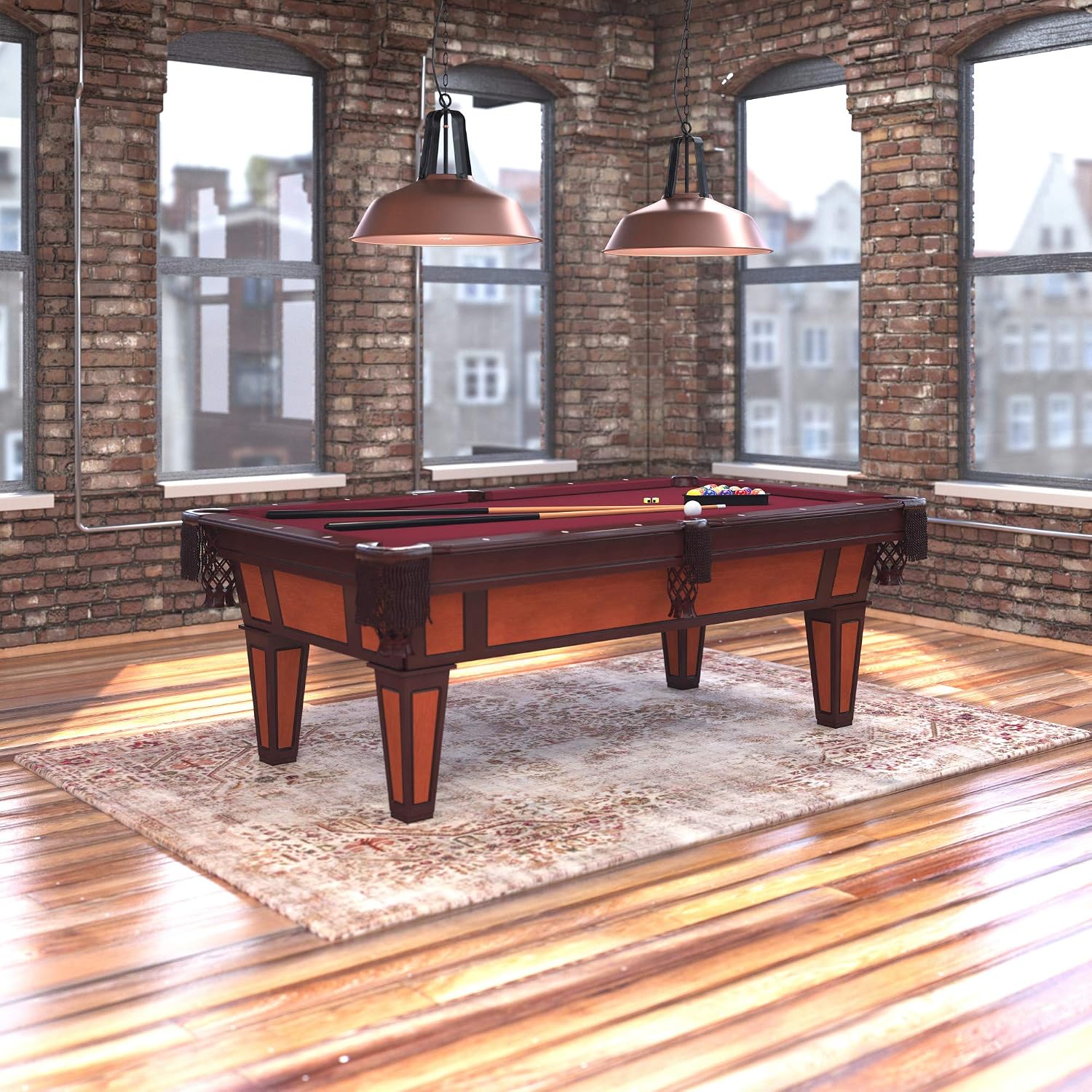
Here’s the thing nobody tells you when you’re shopping for a pool table: nearly every table in the $1,500–$6,000 range looks more or less the same in a product photo. Dark wood cabinet, green felt, six pockets. The marketing copy says things like “professional quality” and “tournament-ready.” But two specs — the cushion profile (the rubber molding that lines the inside of each rail, which is what the ball actually rebounds off) and the cabinet construction (the joinery, material, and finish of the table’s wooden frame) — do more to determine whether you bought a playing instrument or an overpriced decoration than anything else on the spec sheet. This article breaks down what those two specs mean, how to evaluate them, and how to make a confident call when you’re comparing tables side by side.
If you’re mid-comparison between two or three tables right now, this is the framework. We’ll name tradeoffs explicitly, show the relevant numbers, and close with clear if/then decision rules.
| EDITOR'S PICK[Nixon Billiards - Bryant Slate…](https://www.amazon.com/dp/B0BRNZ3LL2?tag=greenflower20-20) | Mid-tier[Fat Cat Reno 7.5 Foot Pool Table](https://www.amazon.com/dp/B00ACOVNKA?tag=greenflower20-20) | Budget pick[Fat Cat Frisco 7.5 Foot Pool Ta…](https://www.amazon.com/dp/B000T06MVW?tag=greenflower20-20) | |
|---|---|---|---|
| Slate Type | — | Accuslate | Accuslate |
| K-66 Cushions | — | ✓ | ✓ |
| Finish | Grayson Grey | Dark Cherry | Oak |
| Accessories | — | Cues and Balls | Cues and Balls |
| Price | $2,799.00 | $1,285.99 | $1,189.58 |
| See on Amazon → | See on Amazon → | See on Amazon → |
What K-66 Actually Means — and Why It’s the Cushion Standard Worth Caring About
A cushion profile is defined by its cross-sectional shape — essentially the geometry of the rubber strip when you cut it from the side. That geometry controls the angle at which the cue ball contacts the rail and rebounds back into the playing field. The number-letter designation (K-55, K-66, U-23, etc.) is a standardized coding system used across the rubber manufacturing and billiards industry.
K-66 is the profile mandated by the Billiard Congress of America (BCA) for sanctioned tournament play. Per the BCA’s Equipment Specifications and Certifications document, regulation tables must use K-66 profile cushions to be certified for competitive use. The “66” refers to a specific nose height and base width that positions the contact point at roughly the midpoint of a regulation cue ball — which produces predictable, consistent rebound angles across the full speed range of a normal shot.
Why does that geometry matter in practice? Owners of tables that shipped with off-profile cushions — common on sub-$1,000 imports — consistently report that balls “die” on the rails at low speed or kick unpredictably on hard shots. That’s not player error; it’s the rubber geometry forcing the ball into a contact point that isn’t calibrated for the 2¼-inch ball diameter used in American pool. Reviewers at This Old House and Bob Vila both flag cushion profile as a primary differentiator when comparing mid-range tables, noting that K-66 compliance is one of the first things to confirm before committing to any table marketed as “tournament-grade.”
K-66 vs. the Alternatives: A Quick Map
| Profile | Typical Application | BCA-Compliant? |
|---|---|---|
| K-66 | American pool, regulation tables | Yes |
| K-55 | Snooker, some billiard tables | No (for US pool) |
| U-23 | Budget/import tables, off-brand rubber | No |
| Super-K (K-66 variant) | Premium OEM, Brunswick/Olhausen | Yes |
The Super-K designation used by Brunswick Billiards is a proprietary refinement of the K-66 geometry, featuring a higher-density rubber compound. Published specs from Brunswick position it as a more durable variant of the same compliant profile — not a different standard, just a tighter manufacturing tolerance within that standard.
Rubber Compound and Aging
Profile geometry matters, but so does the rubber itself. Cheaper cushions use a lower-durometer (harder) rubber or blended compounds that off-gas over time, leading to the stiff, “dead” rebound feel owners of entry-level tables often describe after three to five years. Premium manufacturers — Brunswick, Olhausen, Connelly — specify vulcanized gum rubber for their cushions. Vulcanized rubber maintains elasticity across temperature swings and resists the hardening that kills rebound response. Popular Mechanics’ buying guide coverage of pool tables notes this compound distinction as one reason premium cushions carry a longer expected service life before re-cushioning is needed.
Re-cushioning cost context: If you’re buying a table that ships with off-spec rubber, factor in professional re-cushioning at roughly $300–$600 depending on table size and shop rates. That cost erodes whatever price advantage the cheaper table appeared to offer.
Cabinet Construction: Where Pool Table Meets Furniture
The cabinet — the legs, aprons, rails, and frame that hold the slate bed — is where a pool table earns or loses its right to be in the room for 20 years. There are two conversations happening simultaneously: structural integrity (does the frame hold the slate flat and stable for the life of the table?) and aesthetic integrity (does this thing look like it belongs in the space?).
Solid Hardwood vs. Veneered MDF: The Decision That Matters Most
The most important material call in cabinet construction is whether the frame is solid hardwood, veneered MDF (medium-density fiberboard with a wood-look surface layer), or some hybrid. Here’s the honest tradeoff map:
Solid hardwood (maple, oak, poplar): Dimensionally stable over time, holds fasteners without thread-strip risk, finishes and refinishes well, and responds to wood movement predictably. Tables from Olhausen, Connelly, and Plank & Hide typically use solid hardwood throughout the cabinet structure. Owners across AZ Billiards forum threads consistently report that these frames remain structurally tight after a decade of use and seasonal humidity swings — the kind of long-run data that spec sheets can’t give you.
Veneered MDF: Less expensive to manufacture, visually passable at first glance, but vulnerable to moisture at joints, prone to edge-chip damage, and does not hold fasteners as reliably over time. Most tables under $1,200 use MDF-heavy construction. For a table that will be moved, reassembled, or sit in a basement with variable humidity (a very common installation scenario), MDF cabinet panels are a real liability.
Hybrid construction: Some mid-range tables — including several in the $2,000–$3,500 Viper and Fat Cat upper tier — use solid hardwood for the structural frame members (legs, corner blocks, apron rails) while using veneered MDF for the decorative side panels. That’s a reasonable engineering compromise: the load-bearing skeleton is solid wood, and the cosmetic surfaces are MDF. It performs well for buyers who aren’t expecting heirloom longevity, and it keeps price points accessible.
Joinery: The Invisible Spec That Shows Up Over Time
Frame joinery — how the cabinet pieces connect to each other — is almost never called out in product listings, but owners who’ve reassembled a table after a move know exactly how much it matters. Mortise-and-tenon joinery (where a shaped peg on one piece fits into a matching slot on another, usually glued and sometimes pinned) is the benchmark for furniture-grade strength. Dowel joinery is a step down but still solid in well-fitted applications. Cam-lock and bolt-through hardware — the kind used in flat-pack furniture assembly — is the most common approach on budget tables. It works fine on initial assembly but can loosen over repeated assembly/disassembly cycles.
Per This Old House’s pool table reviews, the assembly and disassembly robustness of mid-range tables is a common owner complaint: cam-lock systems that arrive tight become sloppy after one move. If your table is going to stay in one place for a decade, this matters less. If you’re furnishing a basement that might get converted, or you’re buying for a home you don’t plan to be in forever, furniture-grade joinery is worth paying for.
Finish Quality and Its Design Implications
For game-room designers and buyers who care about the table as a room anchor — not just a playing surface — the finish is where premium tables separate from the pack. Plank & Hide and Connelly both offer custom finish options (English Tudor, Rustic Walnut, Charcoal) that are hand-applied catalyzed lacquer finishes, not spray-applied stain. The difference is visible at close range and under directional lighting. Brunswick’s entry-tier tables use a standard stain/polyurethane finish that reads as furniture-store quality — acceptable, not remarkable.
By the numbers:
- K-66 cushion compliance: required for BCA-sanctioned play; present on most tables $1,500+
- Vulcanized gum rubber cushion lifespan: 25–50 years with normal use, per manufacturer specs from major OEMs
- Re-cushioning cost if non-compliant rubber fails early: $300–$600 at most billiard service shops
- Solid hardwood cabinet premium over MDF-heavy equivalent: typically $600–$1,500 at retail, depending on brand tier
How to Evaluate a Table You’re Currently Considering
If you’re under LOI on a specific model or have narrowed to two or three options, here’s the evaluation checklist that maps directly to what we’ve covered:
On cushions:
- Does the product listing specify K-66 profile rubber? If it says “professional cushions” or “tournament cushions” without naming the profile, contact the retailer or manufacturer for the spec sheet confirmation.
- Is the rubber compound described as vulcanized gum rubber, or is it unspecified? Unspecified usually means blended compound.
- What’s the warranty on the cushions specifically? Olhausen’s published warranty covers cushion rubber for the life of the original owner — that’s a meaningful signal about compound quality confidence.
On the cabinet:
- Is the frame material called out explicitly? “Hardwood” in marketing copy sometimes means hardwood veneer over MDF. Push for “solid hardwood frame” or check the manufacturer’s spec page directly.
- What joinery system is used? If the listing doesn’t say, it’s almost certainly cam-lock or bolt hardware. Not disqualifying, but know what you’re getting.
- If you’re buying from a brand in the Plank & Hide / Connelly tier, are custom finish options available? That matters if the table needs to match existing case goods.
The If/Then Decision Rules
If the table you’re evaluating doesn’t specify K-66 profile cushions and is priced above $1,000: Stop and confirm before buying. At that price point, K-66 compliance should be standard. Non-compliance at $1,000+ usually signals a manufacturer cutting costs on a key performance component, and you’ll likely pay for re-cushioning within five years.
If you’re choosing between a veneered-MDF cabinet at $1,800 and a solid hardwood hybrid at $2,400: The $600 gap is real money, but so is the structural difference — especially if the table will be in a basement with seasonal humidity swings, or if you expect to move it once before it finds its permanent home. The hybrid hardwood frame is the defensible choice for most buyers in that range.
If you’re buying at the Olhausen / Brunswick / Connelly tier ($3,500+) and the cushion and cabinet specs are both solid: The decision moves entirely to finish, size, and room fit. At that tier, all three brands are using compliant rubber and furniture-grade construction — the playing performance difference between them is marginal. Spend your decision-making energy on whether the finish works with your room and whether you want the upgrade pathway of custom felt colorways and matching accessories.
If you’re an amateur player upgrading from a non-slate table under $500: The single most important move is getting to K-66 rubber and a solid-frame cabinet simultaneously. Don’t spend $1,200 on a slate-bed table with off-spec cushions — you’ll have the slate (good) but still not have a properly playing table. The BCA’s equipment standards exist for exactly this reason: they give you a minimum floor that guarantees a calibrated playing experience, regardless of brand.
The two specs in the title aren’t arbitrary — they’re the line between a table that plays like a pool table and a table that looks like one. Know which side of that line you’re on before you sign anything.